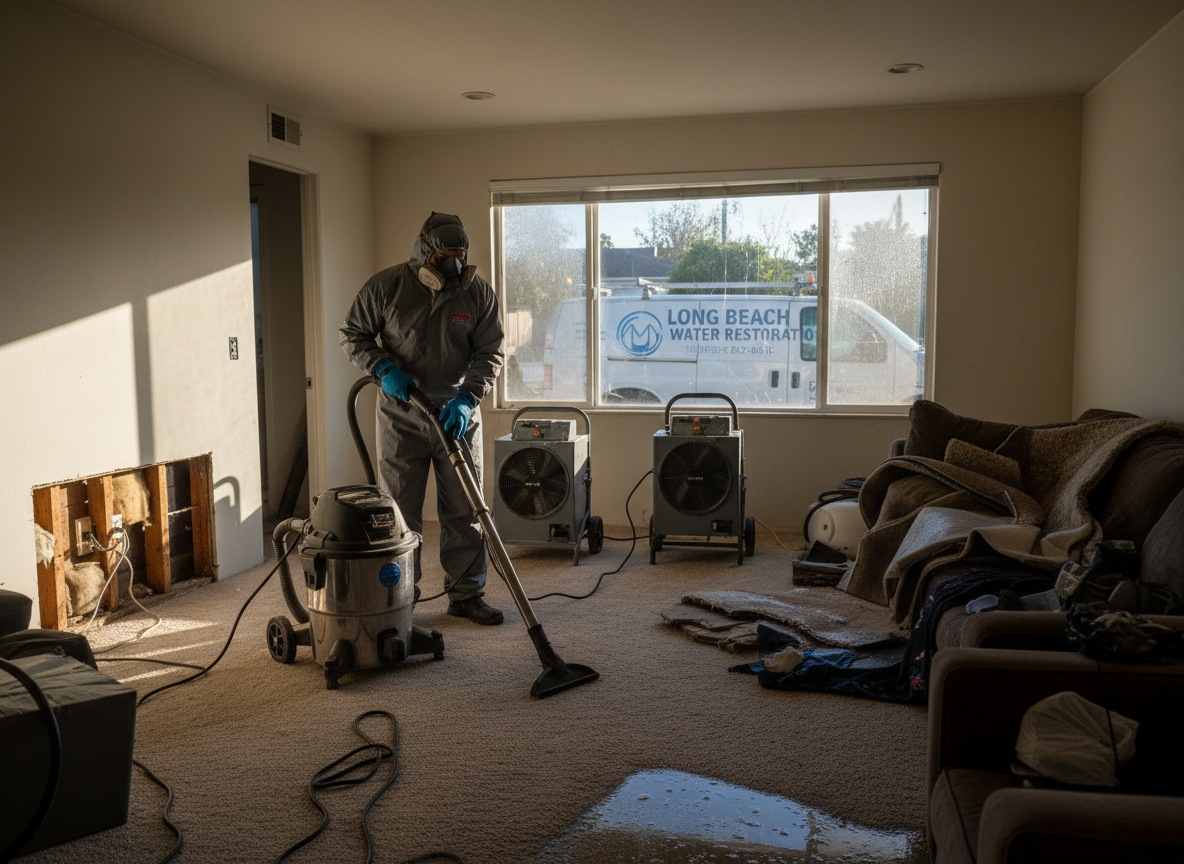
Long Beach housing stock includes many pre-1960 homes with lath-and-plaster walls and older slab-on-grade foundations, especially in Belmont Shore and Naples. These materials absorb and hold moisture longer than modern drywall, so extraction must reach behind baseboards and under tile without creating hidden pockets that later support mold. The mild Mediterranean climate moderated by the Pacific keeps daytime humidity elevated year-round, slowing natural evaporation and requiring industrial dehumidifiers sized for coastal air.
Jobs near the Port of Long Beach or along Pacific Coast Highway often involve saltwater intrusion from storm surges or broken irrigation lines. Salt crystals left in framing or subfloors draw additional moisture from the air, so technicians rinse affected wood and concrete before drying begins. In Signal Hill and Carson, hillside lots can channel runoff toward foundations; crews check grading and French drains before declaring a structure dry.
Los Angeles County building codes require permits for any structural drying that removes load-bearing elements, and inspectors in Long Beach expect documentation of moisture readings at multiple depths. Homeowners in Downtown Long Beach condominiums face additional challenges when water migrates between units through shared plumbing chases, requiring coordination with property management before equipment can be placed.
Carpet and pad removal is routine in Lakewood ranch homes, but older Belmont Shore bungalows often have hardwood over sleepers that must be dried in place to avoid cupping. Technicians monitor equilibrium moisture content daily because the ocean breeze can reintroduce humidity even after equipment is running.
Technician insight
In Long Beach the thing that catches most people out with water damage restoration is how quickly the ocean humidity re-wets plaster and hardwood after the equipment is pulled. Homes built before 1960 in Belmont Shore and Naples hold moisture behind baseboards far longer than newer drywall in Lakewood, so we always insist on final readings at multiple depths before we leave.
Belmont Shore Bungalow Leak
A pipe failure under the kitchen slab sent water into the crawl space of a 1940s home. We found elevated moisture in the original hardwood and lath-and-plaster walls. Extraction and targeted drying over five days prevented cupping and mold while preserving the floors.
Water Damage Restoration Service Services We Offer
✓Water Extraction and Removal
Rapid removal of standing water from slabs, carpets, and crawl spaces using truck-mounted pumps sized for Long Beach residential lots.
✓Structural Drying Services
Placement of air movers and dehumidifiers calibrated for the higher ambient humidity found along the coast from Naples to Signal Hill.
✓Plaster and Drywall Moisture Remediation
Targeted drying behind lath-and-plaster walls common in pre-war homes in Belmont Shore and Downtown Long Beach without full demolition.
✓Hardwood Floor Restoration
In-place drying and sanding of original hardwood floors found in older Long Beach neighborhoods to prevent cupping after water events.
✓Mold Prevention After Water Damage
Antimicrobial application and moisture mapping to stop growth in the humid coastal air that lingers around the Queen Mary and Aquarium of the Pacific areas.
✓Emergency Board-Up and Tarping
Securing openings after pipe bursts or roof leaks in multi-story buildings near Long Beach City Hall and the Port of Long Beach.
Water Damage Restoration Service Cost in Long Beach, CA
| Service | Typical Range | What Affects It |
|---|---|---|
| Initial Assessment And Moisture Mapping | $150–$350 | Larger multi-story homes or those with slab leaks cost more. |
| Water Extraction | $400–$900 | Depends on volume and access in older Long Beach foundations. |
| Full Structural Drying Package | $800–$2,200 | Higher in coastal humidity; includes daily monitoring. |
| Hardwood Or Plaster Drying Add-On | $300–$700 | Required for pre-1960 homes common in Belmont Shore and Naples. |
Ranges are typical for Long Beach, CA and confirmed with an exact written quote before any work starts.
How it works
- 1
On-Site Assessment
Technician arrives at the Long Beach address, maps moisture with meters, and identifies migration paths through older plaster or slab edges.
- 2
Water Extraction
Standing water is removed using pumps and wands suited to residential layouts in Belmont Shore and Naples.
- 3
Drying And Dehumidification
Equipment is positioned for the ocean-moderated climate, with daily readings taken until equilibrium moisture content is reached.
- 4
Restoration And Repairs
Affected materials are replaced or refinished, with final walkthrough to confirm no hidden moisture remains in walls or under flooring.
Pricing
Pricing varies by extent of water migration, number of affected rooms, and whether older plaster or hardwood requires specialized drying techniques.